

Threads of Change: Two Days in Luchun, Yunnan
Luchun sits on a ridge in Honghe prefecture, in the far south of Yunnan, with the Lancang somewhere down in the valley below. The climb is short and steep. From the top of the street you can see the town as a stack of grey-tiled roofs dropping away on both sides of the ridge, and beyond it, mountains already going soft with haze.
I came for two days with one question: what does Hani clothing look like right now — not in a museum case, not in a photograph, but on the people who walked into the shop the next morning.
The evening the town goes blue
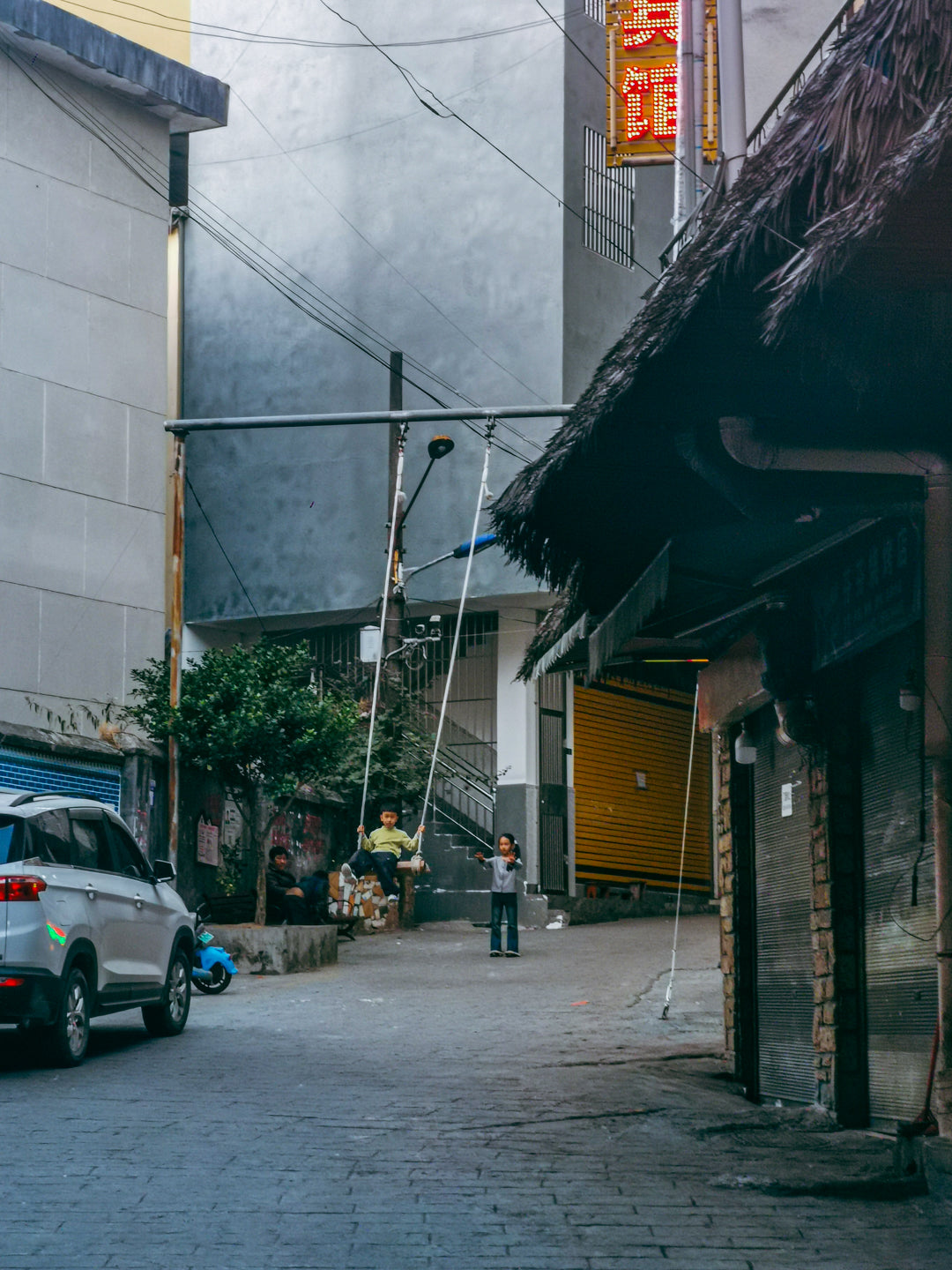
The first afternoon I walked up the old street with no particular plan. It is a narrow lane, paved in flat stone, with whitewashed walls and grey tiles on one side and a thatched eave on the other, red couplets pasted beside a doorway, someone's car pulling through at the far end where the lane turns.
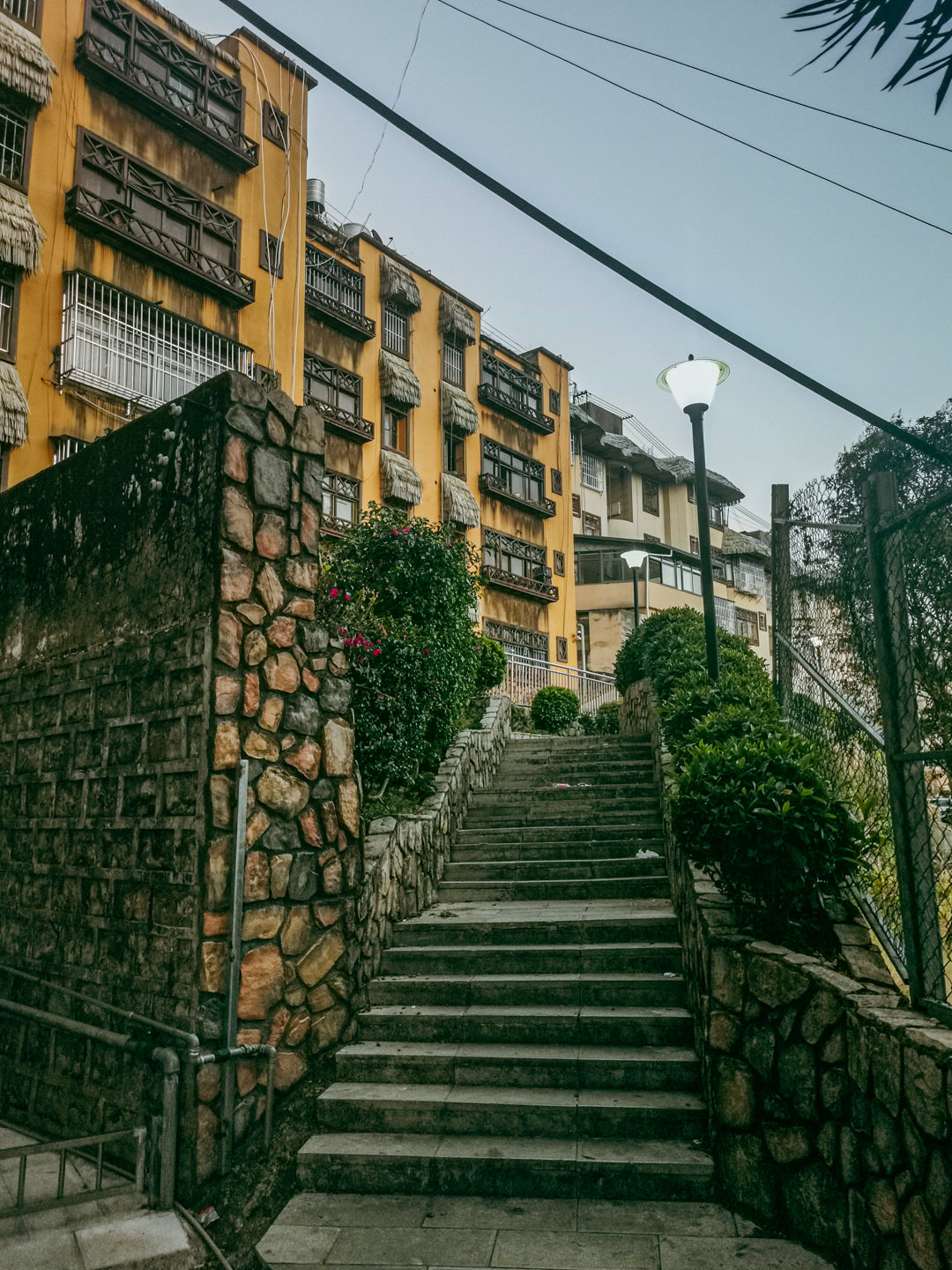
Higher up, the lane turns into steps between a retaining wall and an ochre-yellow building, with banana and other tropical plants pushing up between them and overhead wires crossing the sky. The town is not a museum of itself; it is a place people still live, with the cables and the sodium lamps and the concrete apartment blocks at the edge of the frame.
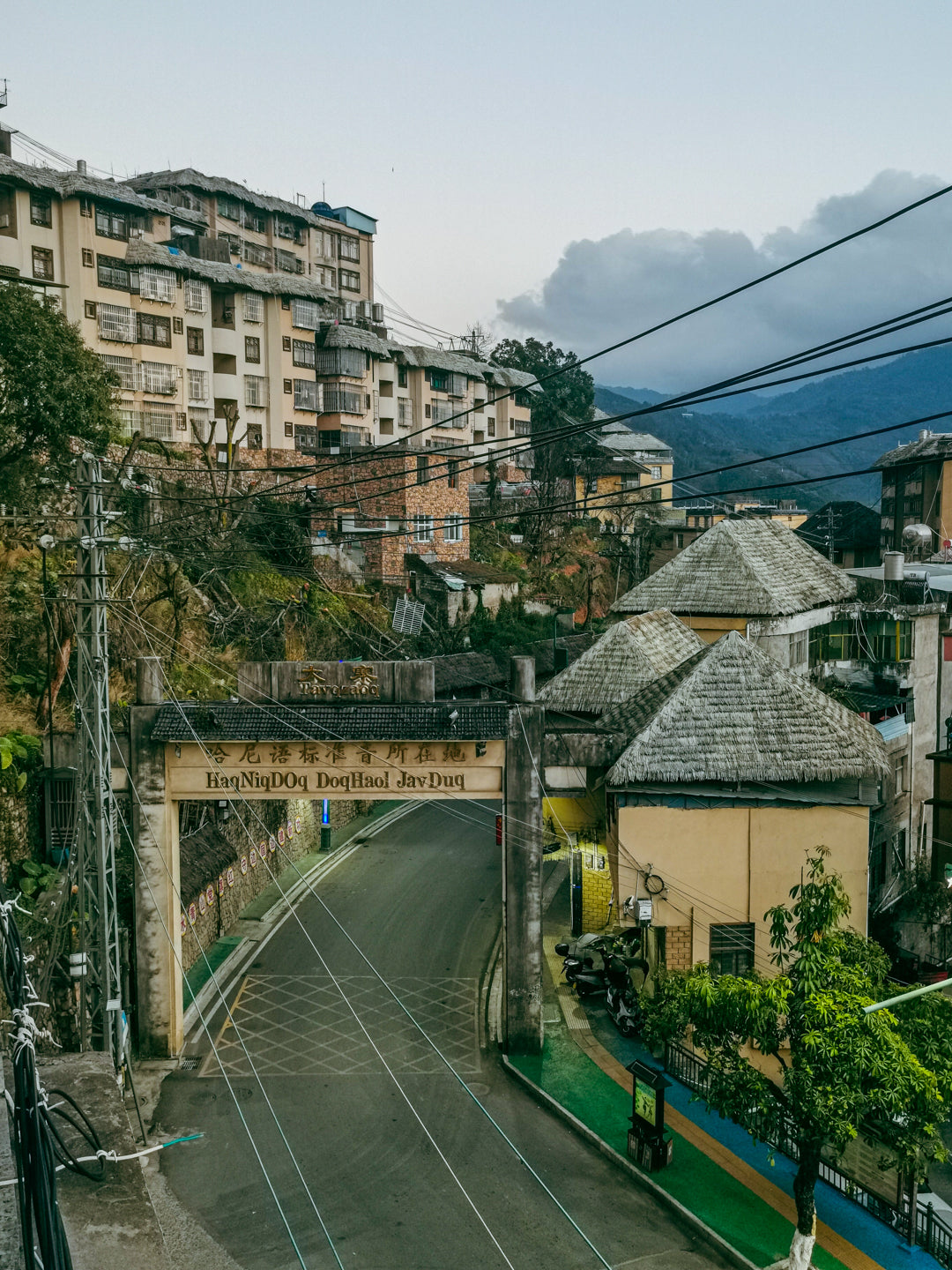
At the end of the walk I found the gate. It is built of stone, and there is script carved across the lintel — Hani characters alongside the Chinese ones — with a small thatched pavilion beside it. By then the sky had gone from orange to that deep blue you only get for ten minutes in the mountains. Someone rode a scooter through the arch. The characters on the gate lit up pale against the dark.
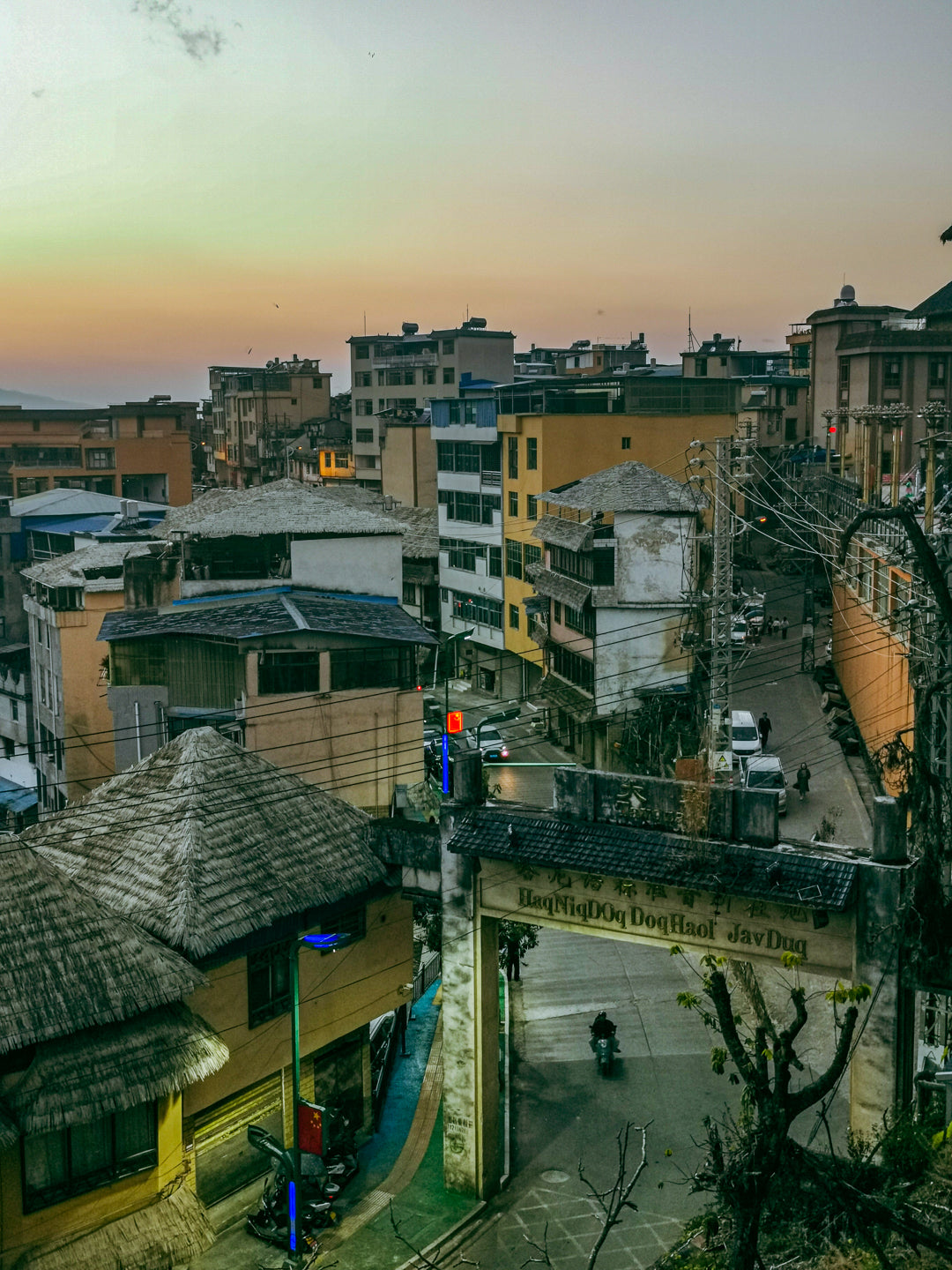
From above, just before the light went, the whole town was orange — the ochre and apricot walls of the old houses, the layered tile roofs, the sky going red over the ridge behind. It is the frame that stayed with me longest.
The shops on the second morning
The next morning was for the clothes, and I was not ready for the amount of colour.
Inside the first shop a woman turned side-on to show a robe of deep blue and purple, the embroidery worked across the whole surface, her head wrapped in cloth to match. Behind her, a rack of headpieces and a wall of red and pink garments. Then the next shop, where everything hung from ceiling rails and walls at once: yellow-green pieces trimmed in purple, solid red pieces, deep blue and violet ones. The saturation is the thing you cannot fake on a screen. It is not a printed pattern, it is thread.
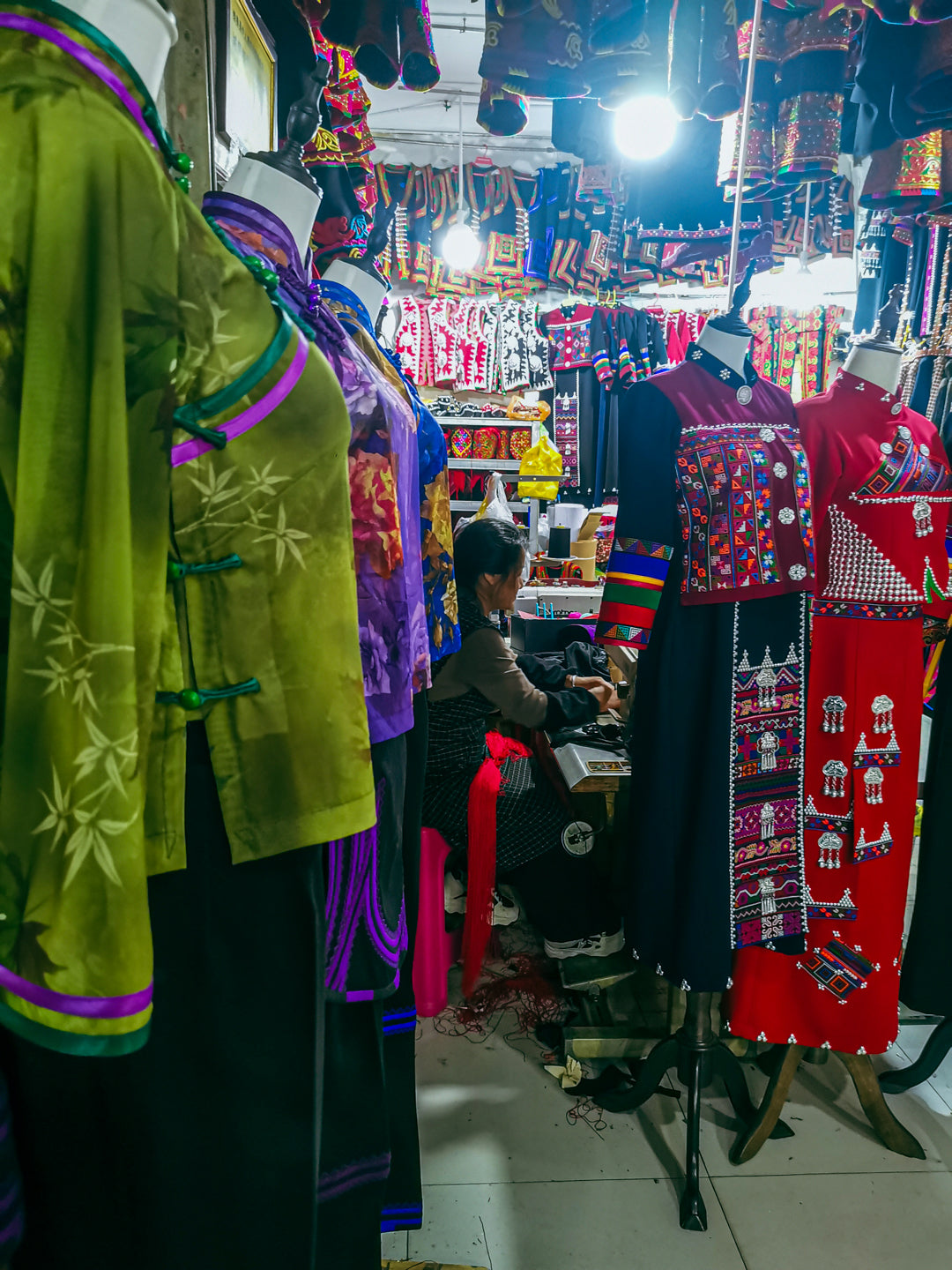
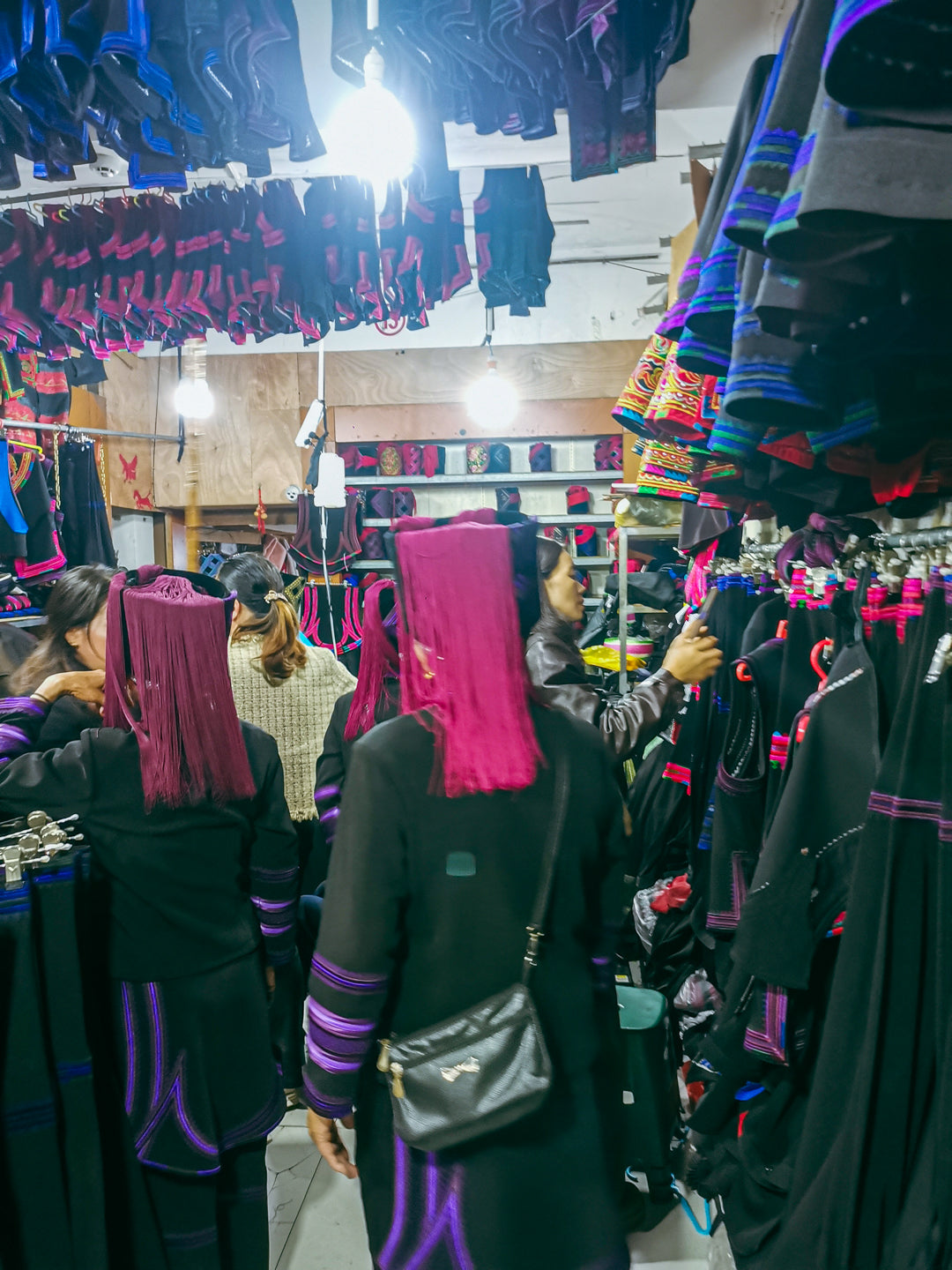
Flash photography does nobody any favours in a shop like that — it flattens everything and makes the dark cloth look grey. But it is also how most of these places are documented, and the clothes in the frame are still more convincing than any of the staged versions I had seen before.
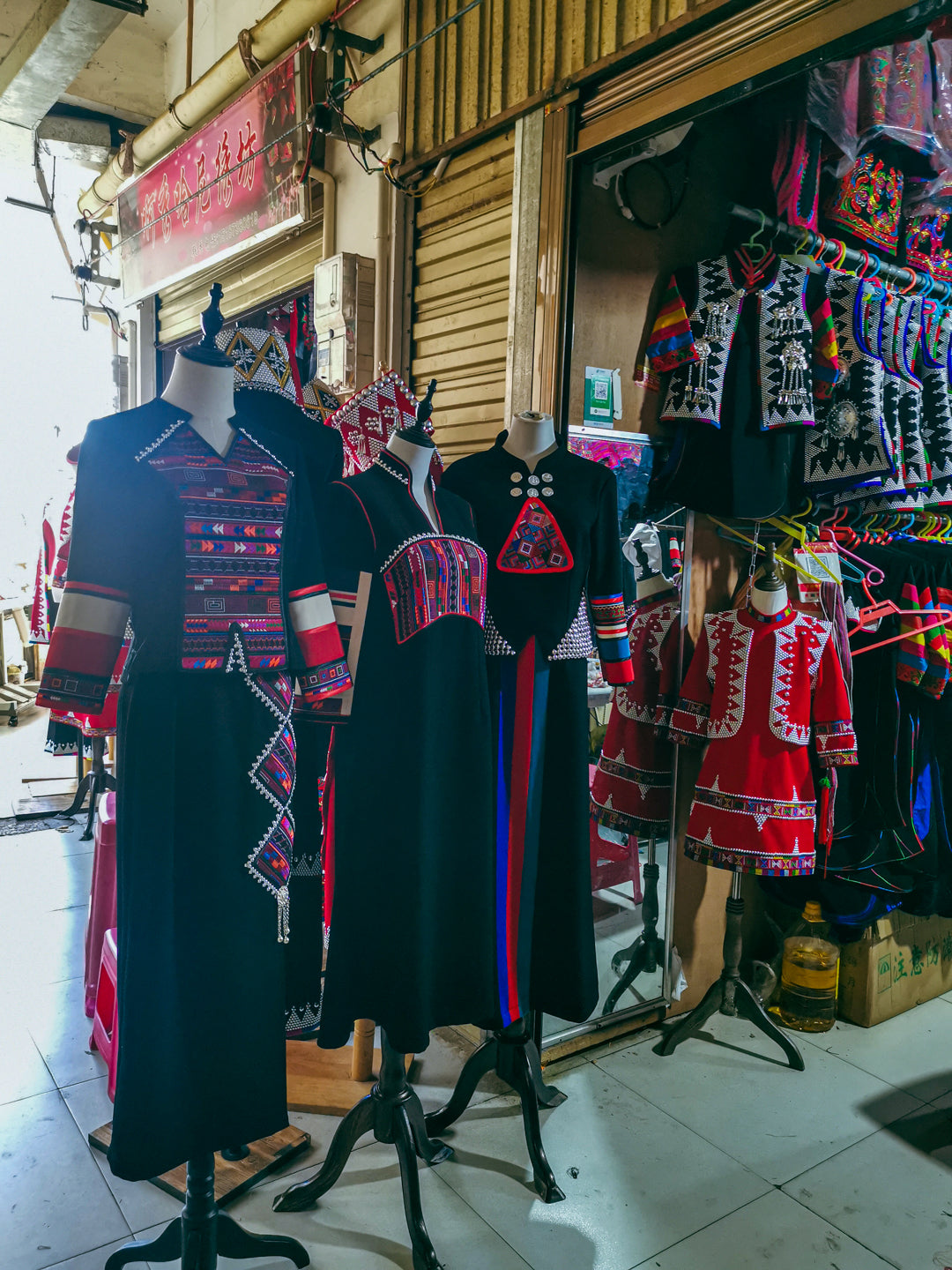
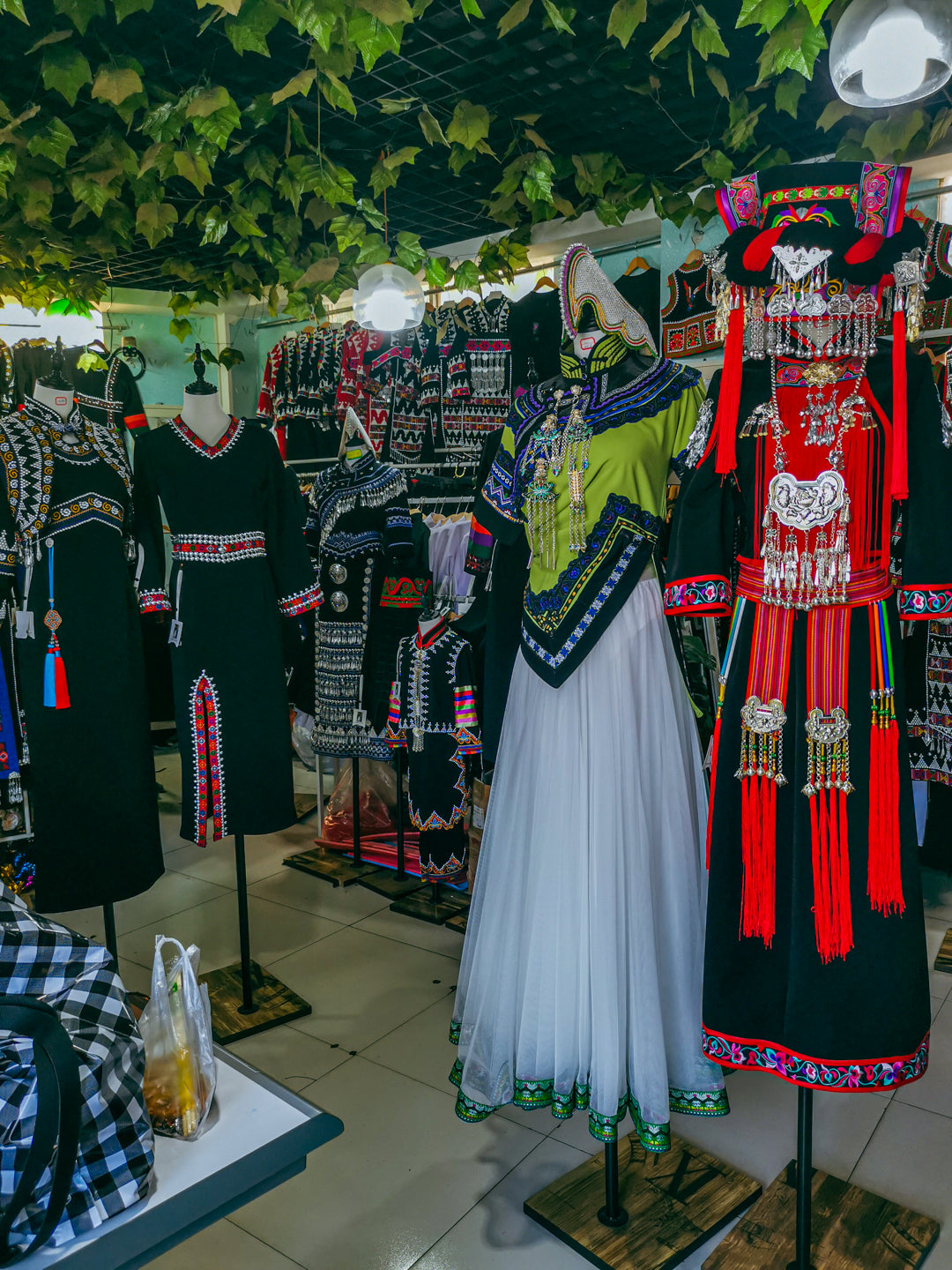
In another shop, the front was painted in cream and yellow stripes, and a mannequin stood outside in a dark jacket finished with a geometric border in red, pink and blue. Inside the same shop, mannequins wore skirts with the same red, black and white geometry, next to a white pleated skirt and some fake vines someone had hung for the look.
The border, and the hands that make it
The thing that stayed with me from the whole trip was not the colour at first — it was the border. Every garment I photographed had a wide band of dense embroidery running along the opening, the hem and the cuffs, and that band is where most of the work is. Geometric blocks, hooked and stepped shapes, in a palette that repeats across the whole garment: red, pink, blue, silver, on a black or dark blue ground.
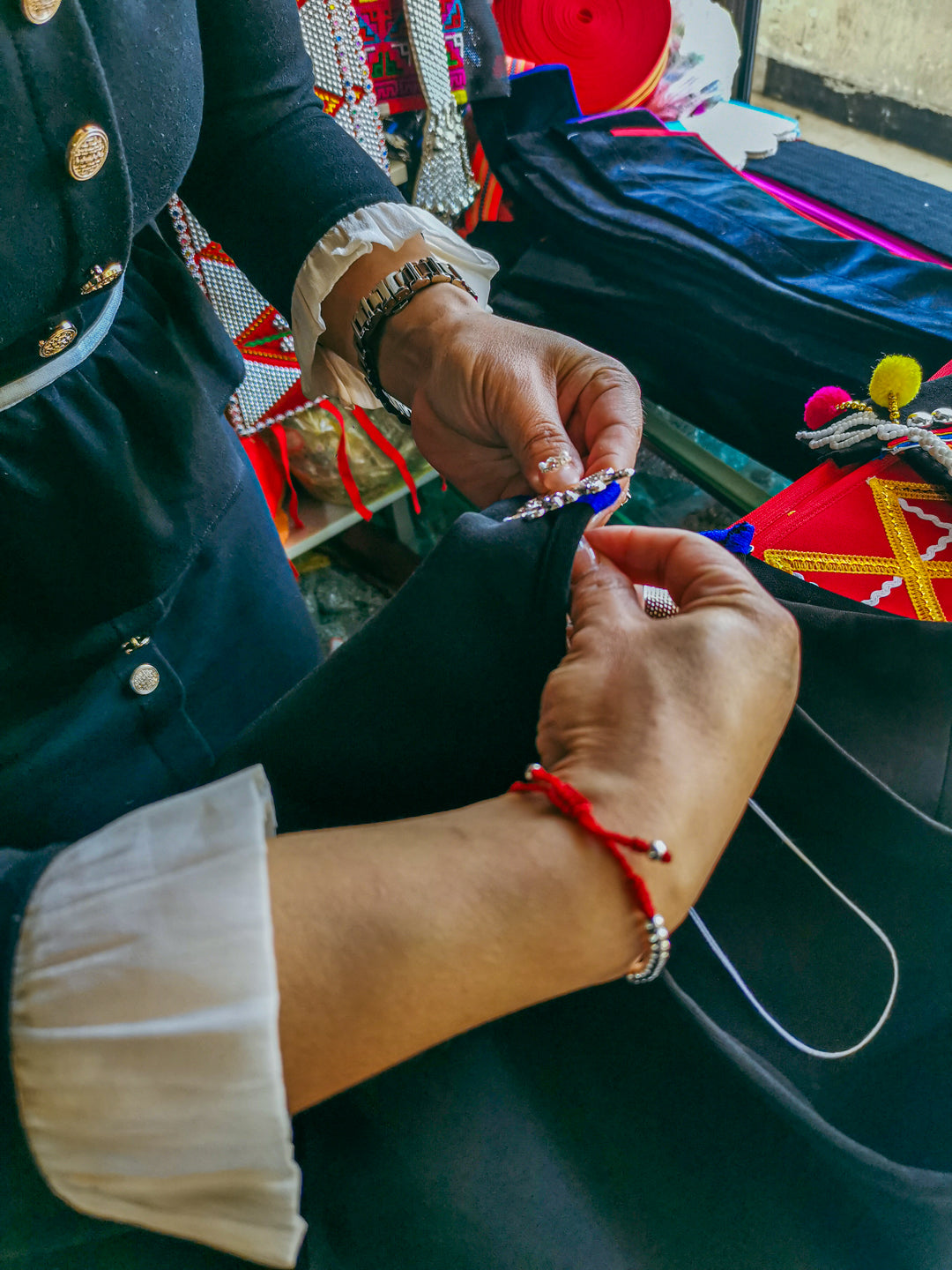
And then, at one stall, a pair of hands doing exactly that. Black cloth stretched flat, a needle working a line of red thread along the edge, the border taking shape one stitch at a time. I stood there longer than was reasonable. It is a slow, quiet thing to watch, and it explains everything else in the shop — every colour, every shape, every piece of weight a garment has.
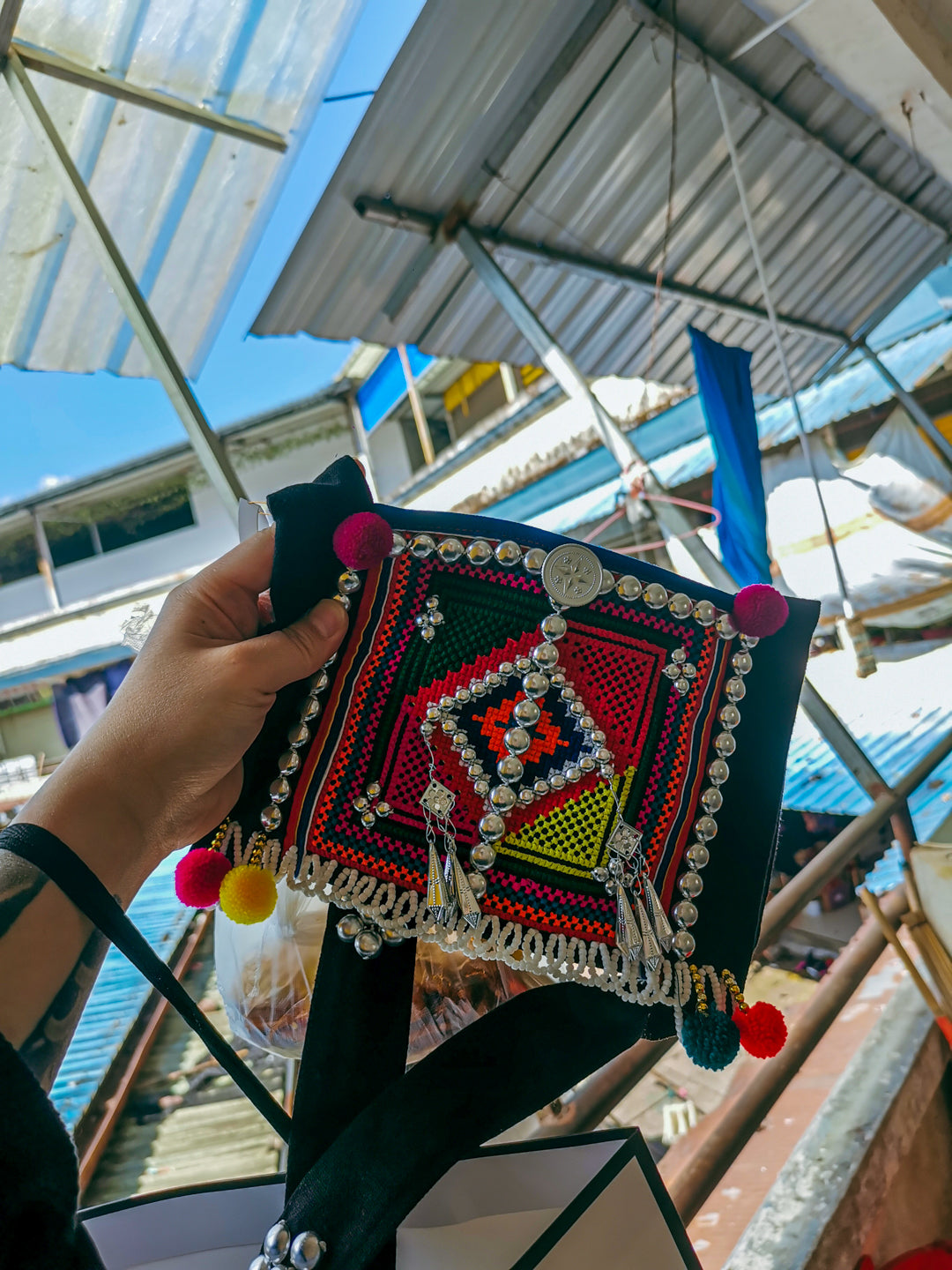
A few stalls along, someone held up a black embroidered panel under a blue tarpaulin: silver coin-shaped ornaments set into it, and squares of colour in red, green and blue, each one worked in the same geometric grammar as the borders. It was the single most beautiful object I saw that week, and it was made to be carried.
What came before
Later the same afternoon I went to the small museum in town, and it changed the scale of everything.
The display cases hold full outfits on white plinths: black cloth, heavy red and orange embroidery around the openings, and headdresses with silver and beadwork attached. One mannequin wears silver chest discs that catch the gallery light from across the room. Round embroidered panels hang on the wall beside them, the same geometry, laid flat. There were other people in the room when I walked in, which felt right — this is a working reference collection, not a shrine.
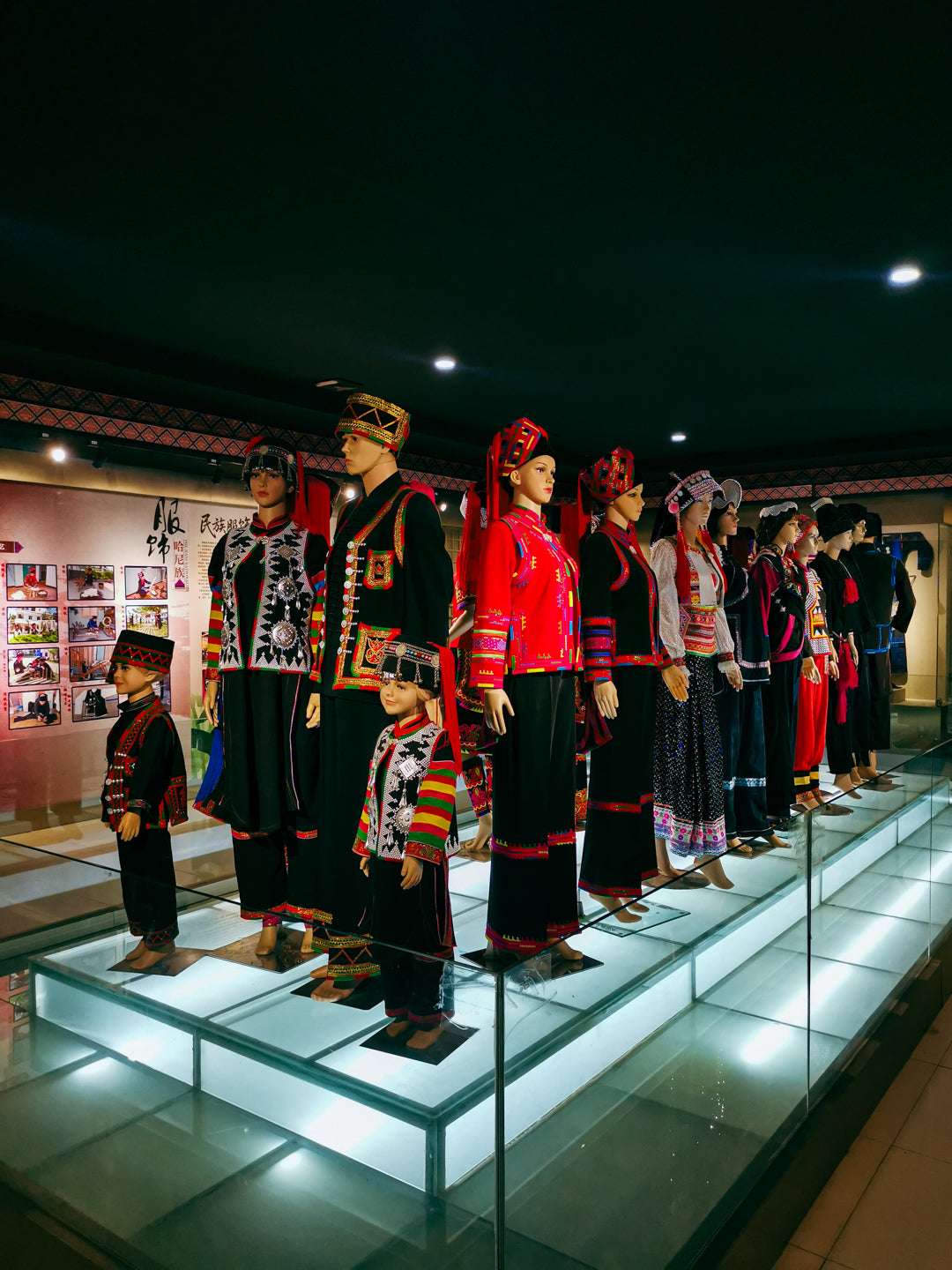
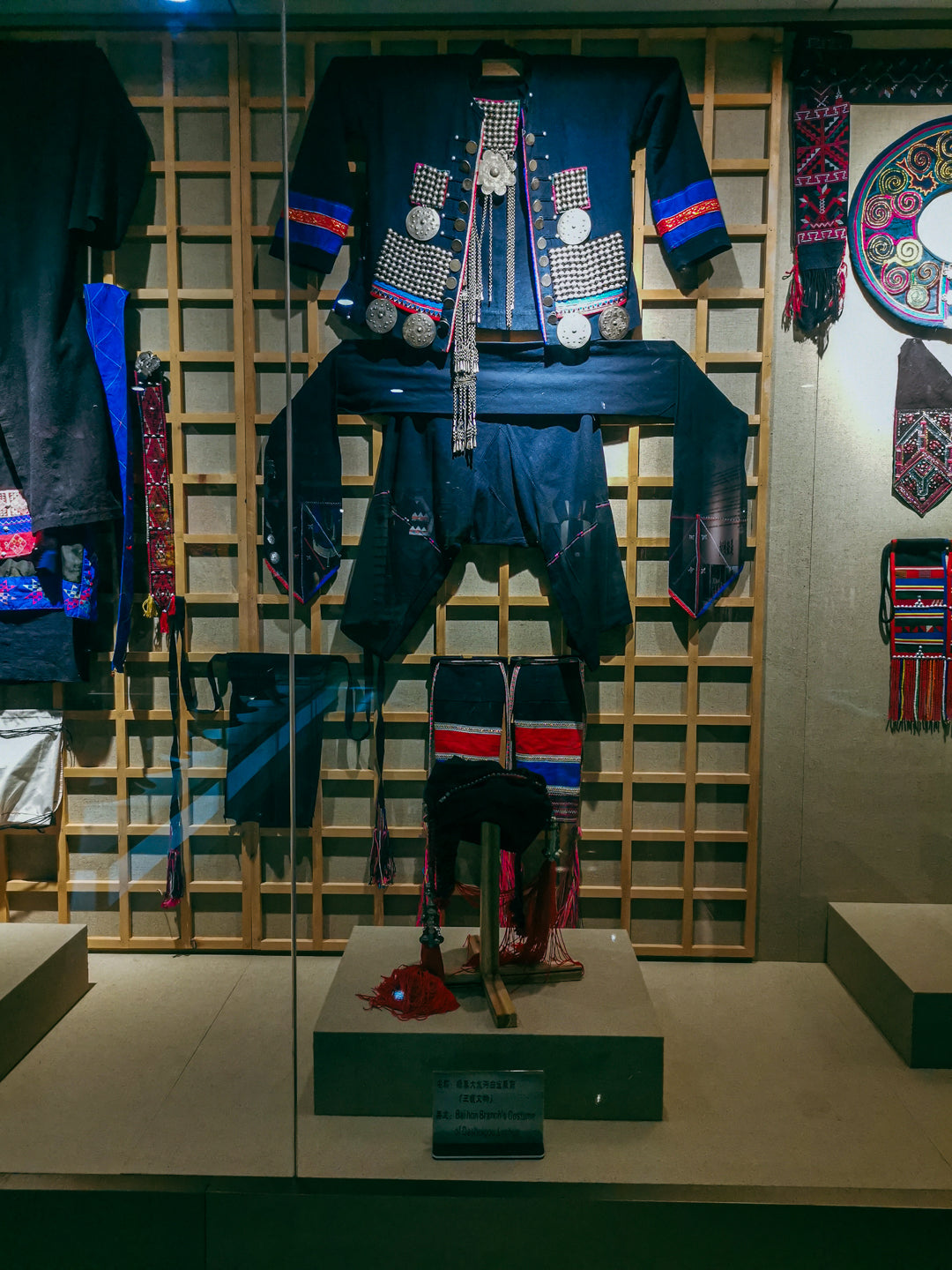
What I did not expect was a television. On a table in the middle of the gallery, a screen was playing a programme about how Hani dress has changed and where women's styles are heading. Above it, a signboard with the title written out in Chinese characters. The museum was telling the same story as the shops, from the other end: what the clothes were, and what they are becoming.
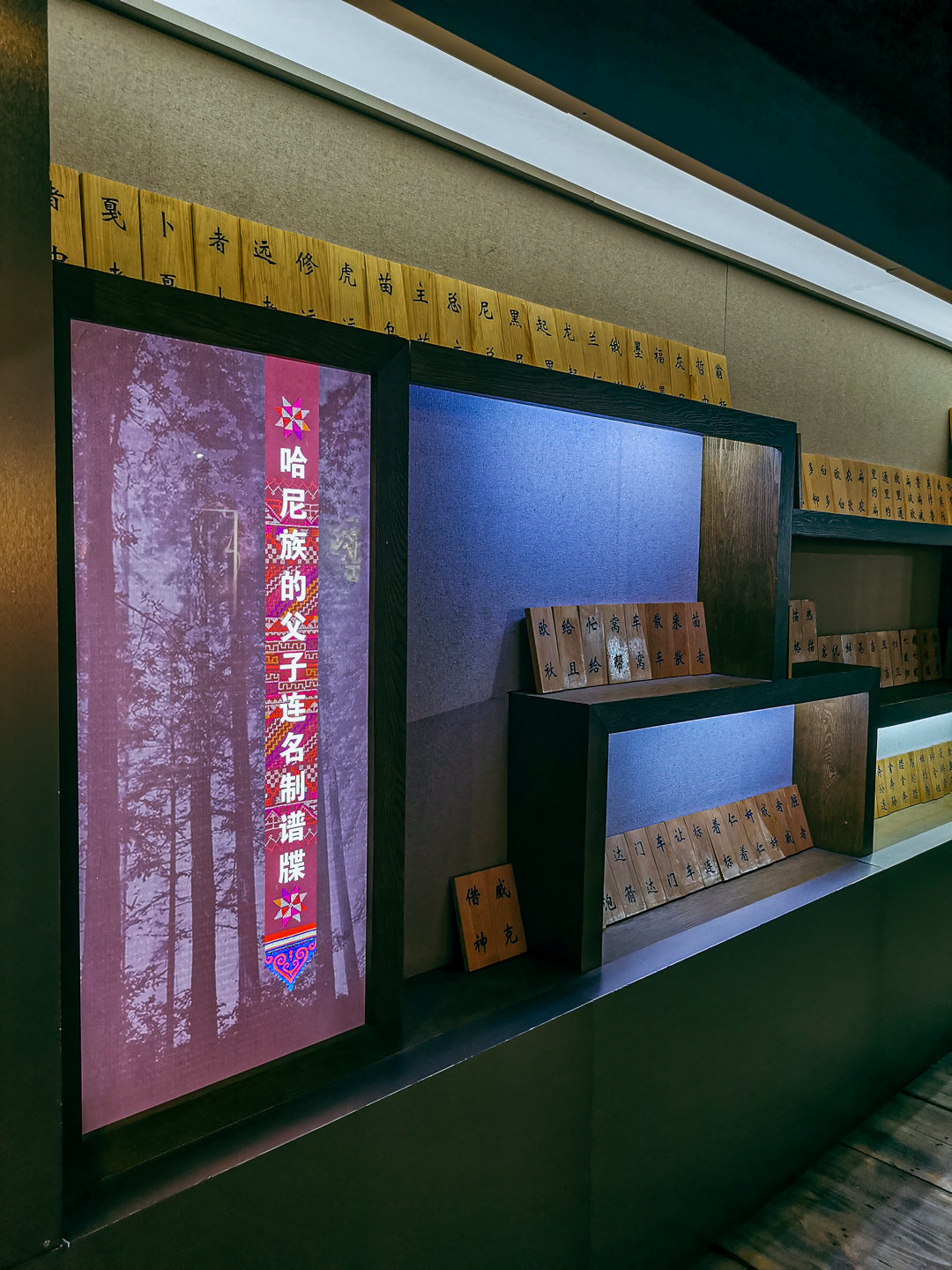
A house, and the things in it
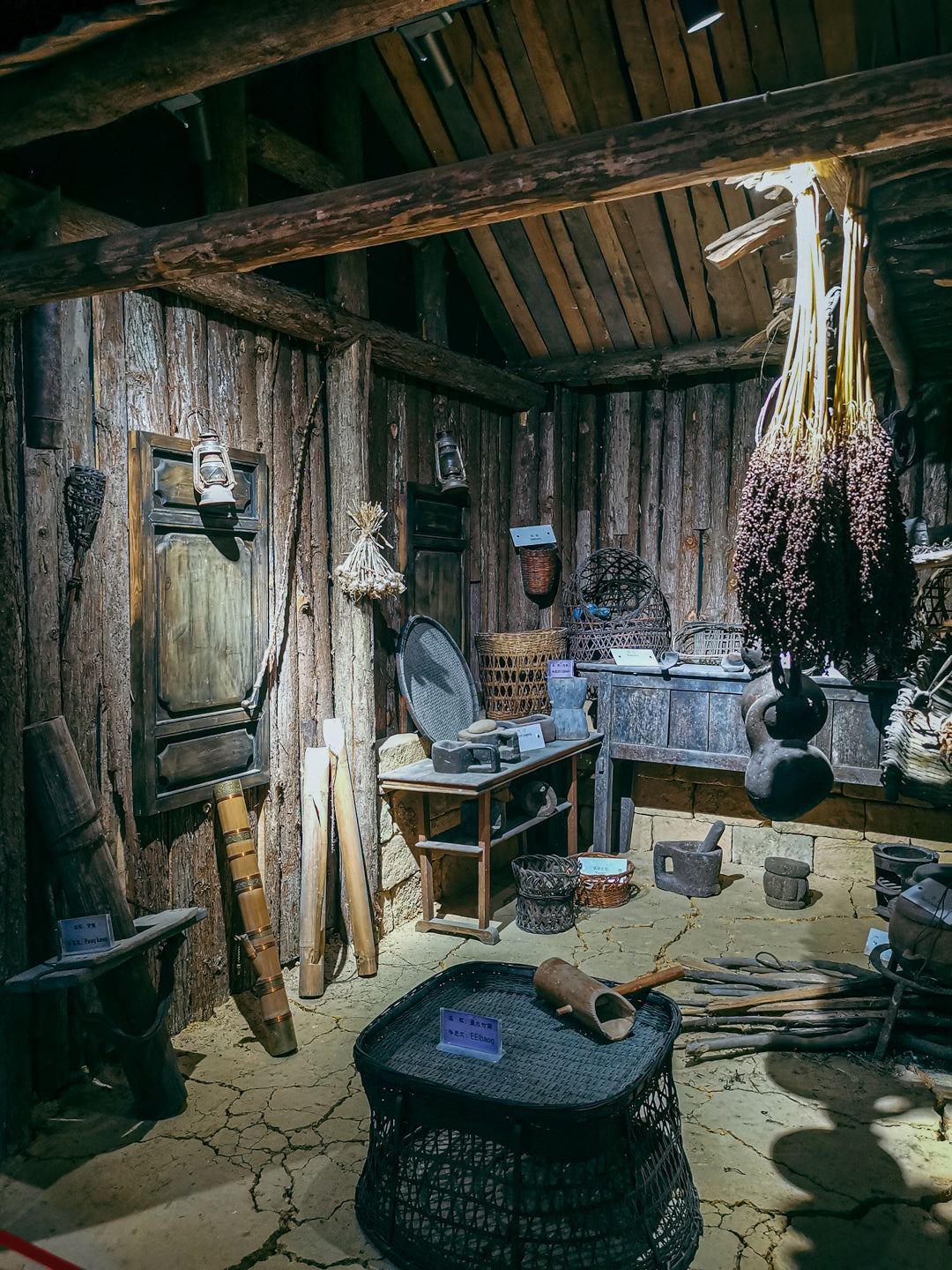
Before the light went again, I was shown a wooden house. This is the part people rarely photograph and the part I remember best: roof beams, a thatch layer above them, a stone cooking area, dried plants hanging from the rafters, a scale on the wall, baskets stacked in the corner, and a big black pot sitting in the ash. The floor is beaten earth. Everything in the room has a job.
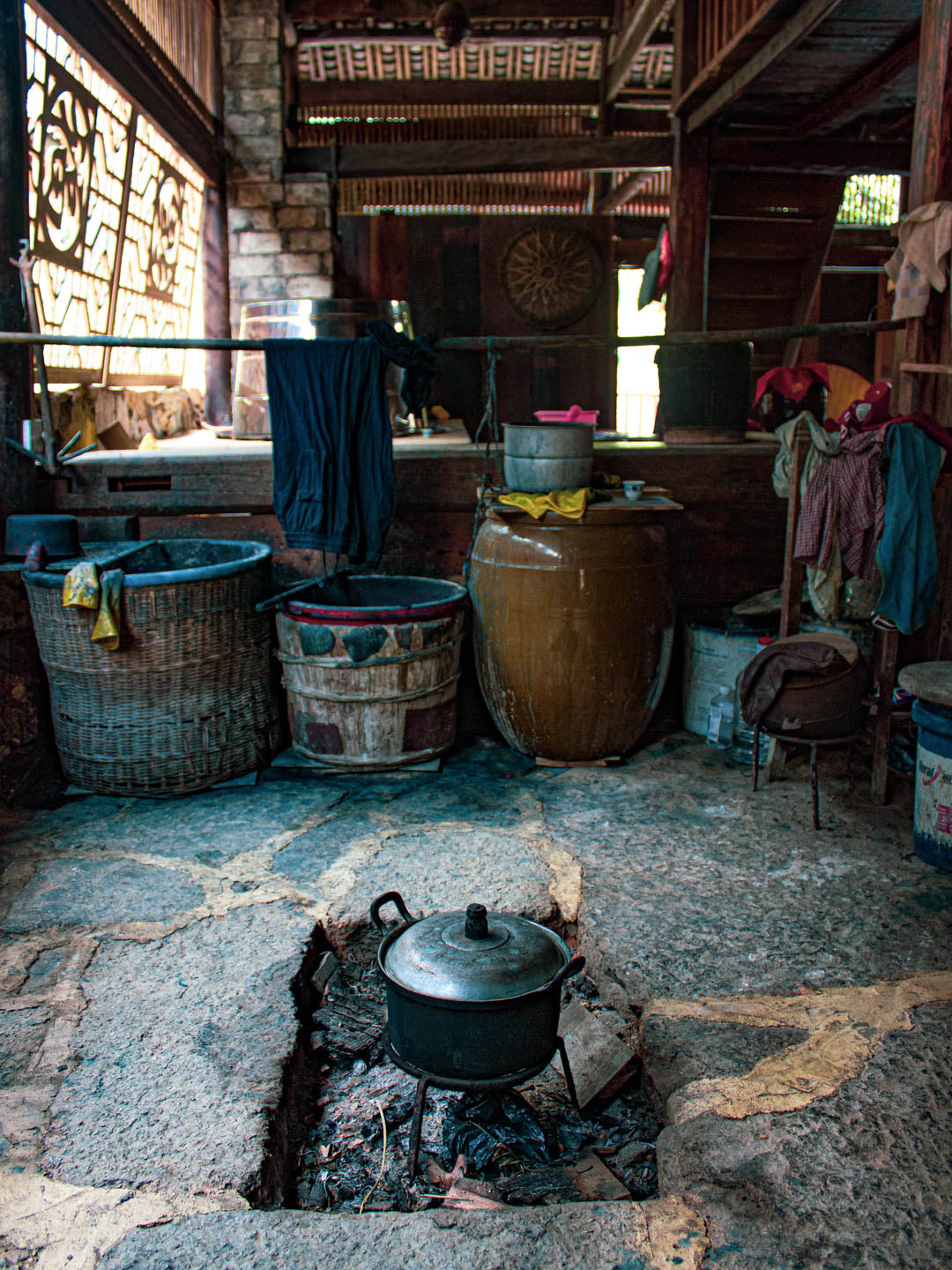
Just inside the door: large clay jars, woven baskets, and a tall carrying basket leaning against the wall. Nothing here was arranged for me. The room simply still works the way it did before.
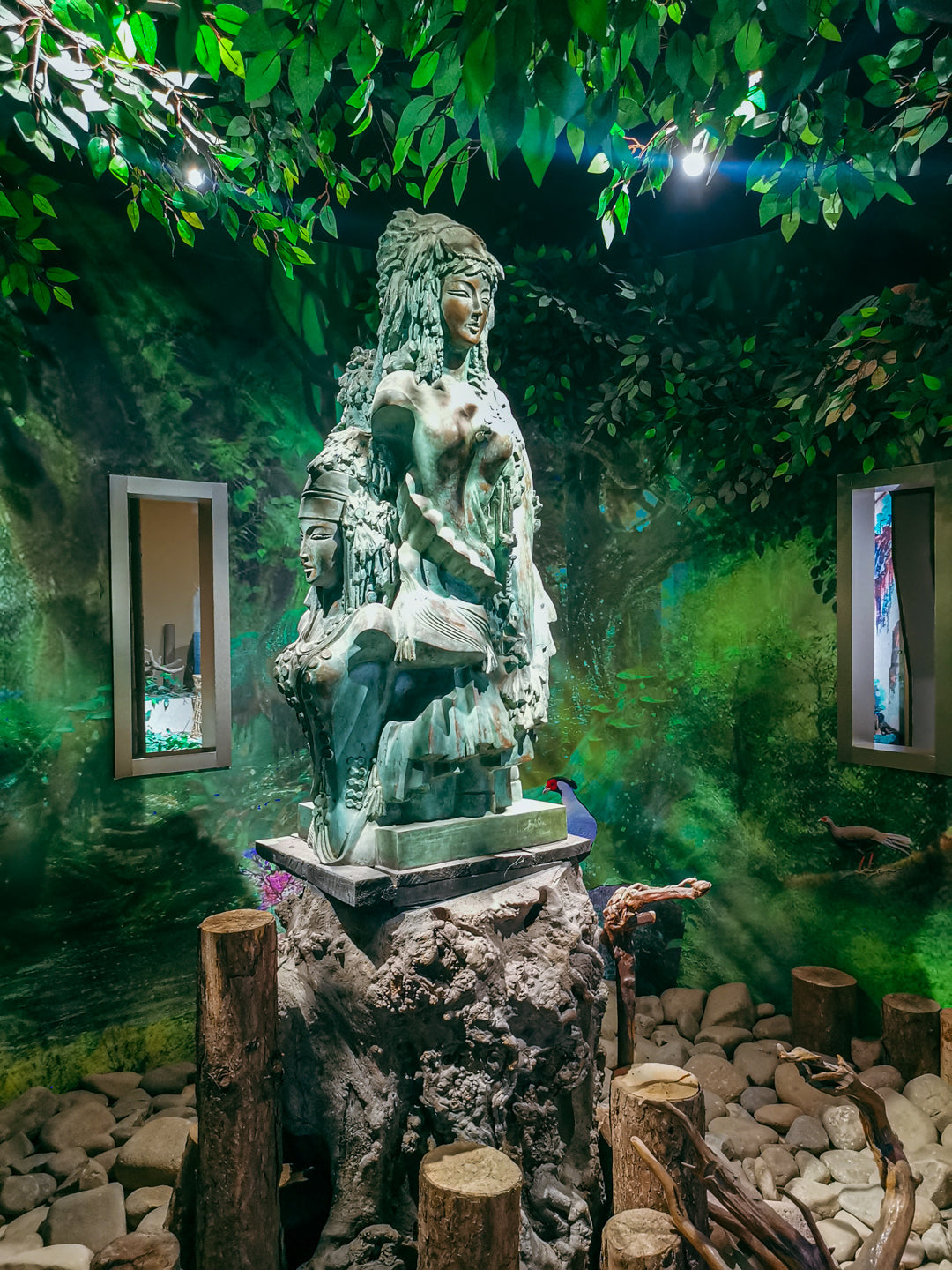
And after dark, in a small garden behind the street, a white figure stood among the greenery with a lit doorway behind it. The town goes quiet at that hour, and for a moment it is hard to tell what is still working and what has become an object.
What I came home with
I did not buy anything for the shop that day, and nothing in the Kongshan collection was made by the people in these shops. What I came home with was a set of observations about borders — how much of the labour sits in one band of embroidery, how the geometry repeats across a whole garment, and how a small square of colour reads as a finished piece when you put it next to an ear.
The closest thing in the collection is the embroidered tube earring with a silver disc: one circle of light, the way the silver catches on the pieces I photographed at the stall. For the colour side of it, the frog-knot fabric earrings pick up the same blocks of red, green and blue that were worked into that embroidered panel. And when I think about the blue hour over the ridge, it is the woven bamboo tray in blue that I keep coming back to.
Embroidered tube and silver disc earrings · Frog knot fabric earrings in multiple colours · Handwoven bamboo tray in blue
Kongshan is based in Kunming, and Luchun is a long way from there. But a border of red thread on black cloth reads the same in any room you hang it in, and that is the whole point of paying attention to it.